
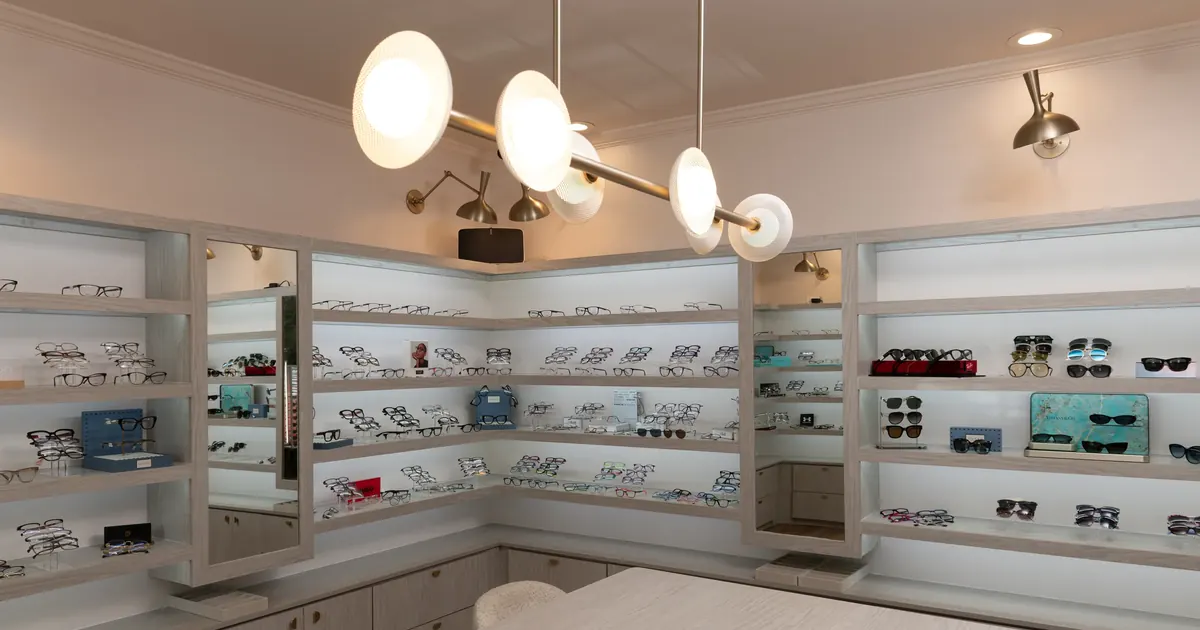
Stand at the frame board in either of our optical showrooms and you will see this season's look: classic rectangles and ovals, narrow ovals with a 1990s feel, translucent acetate (the common plastic frame material), slim metal and light titanium. Every one of those glasses frames looks finished on the wall, and every one of them is empty. Once your lenses go in, the frame decides how thick they look, whether the glasses slide, and whether a progressive lens has room to work.
That is why we tell patients at Classic Vision Care to choose the frame for the lenses that will live in it. Four inputs decide how to choose glasses frames well: your face, your prescription, the fit, and your day, meaning screens, progressives, sports, or a child who plays soccer. Trends are the smallest.
By the end of this guide you will be able to rule out frames that fight your prescription, check fit in thirty seconds, and tell an optician in Kennesaw or East Cobb what you want. We start with the trends, because that is probably what brought you here.
Table of Contents
- What eyewear trends are people in Kennesaw and East Cobb asking about in 2026?
- How does your face shape narrow the choice without deciding it?
- How does your prescription change which glasses frames look and feel right?
- How should glasses frames fit, and what do the three numbers on the temple mean?
- Which glasses frames work best for progressive lenses?
- What should screen-heavy workers choose: computer glasses or blue light glasses?
- How do you choose glasses frames for kids and for sports?
- What about the Georgia sun and sensitive skin?
- When should you adjust, repair or replace your glasses frames?
- What should you say to the optician at our Kennesaw or East Cobb optical showroom?
- Key Takeaways
- Frequently Asked Questions
- Related Reading
- Sources
- Next Steps
What eyewear trends are people in Kennesaw and East Cobb asking about in 2026?
Choosing eyewear is a decision most adults make again and again. In a Vision Council survey of 12,058 US adults in 2024, about two in three said they use some form of prescription eyewear, a figure that includes prescription sunglasses and contact lenses. So which glasses frames to buy is a routine question, and the trend hook changes every year.
An August 2026 men's frame-board analysis in Eyecare Business said geometric, architectural square, softened round and navigator-inspired shapes "are replacing the ultra-shallow rectangles that once filled every board" and that "Lightweight titanium resonates with those seeking all-day comfort and durability". One fall and winter 2026 trade report, covering a single distributor's seasonal showing, added classic rectangular and oval shapes, "narrow oval shapes, which invoke a 1990s and early 2000s aesthetic", and translucent acetate as "a current staple." That is one report on one showing, so treat it as a snapshot rather than an industry survey.
Now the honest paragraph. Trends change yearly. This post replaces a 2019 trend list on our site that aged out, and a 2026 list will age out too. The good news is that smaller classic shapes, deeper frames and light titanium are friendlier to moderate prescriptions and progressive lenses than the oversized or ultra-shallow frames of a few years ago. A narrow oval in translucent acetate is on trend, and its small eye size (the lens width) is what a strong minus prescription (the kind that corrects nearsightedness) wants. Pick the look you like, then test it against the four inputs below before you buy.
How does your face shape narrow the choice without deciding it?
Face shape is where every other guide starts, so here is the principle in two sentences. Angular glasses frames add definition to a rounder face, and curved frames soften an angular one. Most people can borrow from two shape categories, which is why our opticians rarely insist on one correct shape.
Our post on how to choose glasses that flatter your face shape covers the common shapes one by one, so we will not repeat the list. What matters here is what face shape cannot tell you: lens thickness, slipping, and whether a progressive lens has room. Your prescription, the fit and your day decide those, so this guide spends more time on them.
Bring two shapes you like to the optician, not one, so the next sections can break the tie.
How does your prescription change which glasses frames look and feel right?
Why do nearsighted lenses look thick at the edges?
A minus lens, the kind that corrects nearsightedness, is thinnest in the center and thickest at the edge. The bigger the lens, the farther the edge sits from the center, so the thicker it gets. In our opticians' experience, cat-eye and large square shapes put the thickest part in the corners, where it is hardest to hide.
A second factor is decentration: the gap between the frame's optical centers and where your pupils sit. A wide frame on a narrow face forces the lab to shift each lens outward, and that shift adds edge thickness. A published dispensing example in 20/20 Magazine shows how much. A -8.00 lens in standard plastic with 4 mm of decentration had a 9.4 mm edge. A thinner 1.60 index material cut that to 8.1 mm. Removing the decentration alone cut it to 6.3 mm, "a reduction of 33 percent from the original job."
Why do farsighted lenses get thick and heavy in the middle?
A plus lens, the kind that corrects farsightedness, is the opposite: thick in the center, thin at the edge. A tall or oversized frame means more lens, more weight on your nose, and a more magnified look to your eyes. How much depends on your prescription and the frame.
The rule for both cases comes from an American Optometric Association (AOA) clinical practice guideline, last revised in 2010. Frames should be "strong but lightweight, no larger than necessary to accommodate facial size, and chosen to allow the frame pupillary distance to approximate the patient's interpupillary distance (IPD)." Your pupillary distance is the distance between your pupils, which our opticians measure. The frame's pupillary distance is where its lens centers sit. The closer the two, the thinner and lighter the result.
Do thinner high-index lenses fix the problem on their own?
High-index lenses bend light more efficiently, so the same prescription can be made thinner; the American Academy of Ophthalmology (AAO) calls them the thin, lightweight option for strong corrections. The AOA guideline says high-index or aspheric designs should be considered for high lens powers, which "generally applies to corrections of over 6 D of myopia or hyperopia, although the advantages may be noticeable in patients who require as little as 3 D of correction." A diopter, written D, is the unit of lens power on your prescription. Aspheric means a flatter lens curve that reduces bulge.
The index helps on top of good frame geometry, not instead of it. In the example above, removing decentration saved more thickness than the material upgrade did. Spend on the lenses rather than the frame. As the AAO puts it, "spending more on frames doesn't mean you'll end up with better-quality eyeglasses." One caution: polycarbonate, the impact-resistant material, can show color fringing at the edges of strong prescriptions, and the AAO notes that Trivex is less distorting than polycarbonate.
Which frame features help most with a strong prescription?
Choose a smaller eye size. Choose a full rim, plastic or metal, that hides and supports the lens edge. Choose a frame whose centers sit close to your pupil distance. For minus powers, favor shapes without sharp corners. For strong plus powers, favor a shallower, lighter frame with adjustable nose pads. Any specific millimeter limit is our practice's experience rather than a published rule, so ask the optician to compare two sizes on your face. The licensed opticians in our optical showrooms measure pupillary distance at every fitting.
How should glasses frames fit, and what do the three numbers on the temple mean?
Comfort sounds subjective, but most of it can be checked in thirty seconds.
What do numbers like 52-18-140 mean?
Look inside the temple of any pair of glasses and you will usually find three numbers. The first is the lens width, often called the eye size, in millimeters. The second is the bridge width, the gap between the lenses where the frame rests on your nose. The third is the temple length, from the hinge to the tip behind your ear. If a pair already fits you well, note its three numbers and use them as a starting point rather than a target.
Pad arms hold the nose pads on a metal frame, and the AAO notes they are "adjustable to fit the natural shape of your face."
Where should a well-fitted frame touch your head?
Andrew Bruce, a master optician writing in 20/20 Magazine, gives the standard: "The frame should be touching the head at only three points", the bridge of your nose and the spot behind each ear, with each temple curving just above the ear and following the line of the back of the ear. Opticians also set a slight forward tilt, called pantoscopic tilt, so you look through the correct part of the lens. Bruce puts it at "usually 5 to 15 degrees".
Three more checks are what our opticians look for rather than cited rules. Your eyes should sit centered in the lenses. Your eyebrows should sit just above the top rim. No lashes should touch the lens.
Why do your glasses keep sliding down your nose?
Sliding glasses usually touch in the wrong places; they rarely need replacing. A 20/20 Magazine staff guide to fitting puts it simply: "If the temple bend is too short, the temples will ride up." If too long, the glasses slide down the nose. On a metal frame, the nose pads can be moved closer or wider. On a plastic frame, the frame itself is reshaped; the AAO notes that "Zyl frames are easy for an optician to adjust." Zyl is another name for acetate.
The fix takes minutes. For more on fit, see our post on choosing the most comfortable glasses for you. Before you buy, put the frame on, look down and shake your head gently. If it moves, ask for an adjustment or try the next size.
Which glasses frames work best for progressive lenses?
Progressive problems are often frame problems.
What is fitting height, and why does frame depth matter?
A progressive lens puts your distance correction at the top, your reading correction at the bottom, and a gradual change between them with no visible line. The AAO notes that progressive lenses can cause more distortion than other lens types, which is one reason the frame has to give the design room.
The key measurement is fitting height. A continuing education course for opticians in 20/20 Magazine defines the minimum fitting height as "The distance from the Fitting Point to the center of the reading area." The fitting point is where your pupil sits in the lens. Every progressive design has a minimum, and the course recommends a frame that gives 2 to 4 mm more than that minimum so the reading area stays usable.
Frame depth is where this bites. A shallow frame forces a shortened progressive design, which the course says was often "significantly compromised by poor peripheral acuity, inadequate intermediate utility, excessive swim". In plain words: blurrier edges, a weaker middle zone, and a swaying feeling when you turn your head.
Our opticians measure segment height, the distance from the bottom of the lens to the fitting point, with the frame adjusted on your face first. That order is why buying progressives online without a fitting is a gamble. If you are new to reading correction, our presbyopia page explains the options.
How long does it take to get used to progressive lenses?
The AAO says "It might take anywhere between a week to a couple of months to adapt and learn the correct way to look through the lens." A frame that slips moves the reading zone with it, so a stable fit matters more for progressives than for single-vision lenses.
What should screen-heavy workers choose: computer glasses or blue light glasses?
Patients who work on screens all day ask this most, and both professional bodies have answered it.
Do blue light glasses actually work?
The AAO position is direct: "there is no scientific evidence that blue light from digital devices causes damage to your eye." It adds that "The Academy does not recommend any special blue light-blocking eyewear for computer use".
So why do screens feel tiring? Blinking. People "normally blink about 15 times in one minute" but only about 5 to 7 times a minute at a screen, and the AAO ties that drop to eye strain and dry eyes. If screens leave your eyes tired, bring that to your eye exam rather than to an online checkout.
What are computer glasses, and who benefits from them?
The AAO is explicit: "Be aware that computer glasses for reducing eye strain are not the same as 'blue light blocking' glasses." Computer glasses carry a correction designed for focusing at screen distance, what opticians call an occupational lens. The AOA explains why that matters: "Eyeglasses or contact lenses prescribed for general use may not be adequate for computer work."
Habits help too. The AOA suggests the 20-20-20 rule: every 20 minutes, look at something 20 feet away for 20 seconds. It also recommends placing the screen 15 to 20 degrees below eye level and about 20 to 28 inches away. Ask about an anti-reflective coating as well, since "Anti-reflective coatings reduce glare."
The screen distance you report changes the lens we suggest more than any frame does, so tell us how many hours a day you spend on a screen and how far away it sits. Our page on computer eye strain covers the habits in more detail.
How do you choose glasses frames for kids and for sports?
What makes a good first pair of glasses for a child?
The American Association for Pediatric Ophthalmology and Strabismus (AAPOS) is clear: "Getting a good fitting frame from an experienced optician is very important." The frame should be comfortable, with each eye centered behind its lens. For lens material, AAPOS says polycarbonate lenses "offer the best protection as they are shatterproof." Shatterproof is their word; as general optician guidance, impact resistant is not the same as unbreakable. The trade-off is scratching: EyeWiki notes that "polycarbonate is the most easily scratched plastic, thus requiring a scratch-resistant coating."
For the smallest children, the AAO says soft plastic frames are good because they "are bendy and less likely to hurt the child in a fall." To keep glasses on an active child, AAPOS suggests a strap or silicone temple tips. For worried parents: "Most children will adjust to wearing glasses within two weeks." A children's eye exam is where the prescription and the fitting conversation start.
Can kids wear regular glasses for sports?
No. The National Eye Institute states that "Regular eyeglasses, sunglasses, and contacts don't protect kids from eye injuries." It adds that "wearing the right protective eyewear can prevent 9 out of 10 sports-related eye injuries" and that most protective eyewear can be made to a child's prescription.
A joint AAO and American Academy of Pediatrics policy statement names the standard: "Eyewear that passes ASTM F803 is safer than streetwear eyewear for all sports activities with impact potential." ASTM F803 is the US performance standard for sports eye protectors. The same statement notes that "Baseball and basketball are associated with the most eye injuries in athletes 5 to 24 years old." The AAO adds that regular eyeglasses "can make an injury worse if they shatter."
Our post on how to choose the right sports eyewear covers the goggle styles. Ask for polycarbonate or Trivex for any child, and ask whether the sport calls for ASTM F803 eyewear.
What about the Georgia sun and sensitive skin?
What should you look for in prescription sunglasses?
Georgia summers are long and bright, so prescription sunglasses are a lifestyle input for most of our patients. The AAO says to look for a label reading "100% UV protection from all types of UV light". For long hours outdoors, "Wraparound-style sunglasses offer even more protection by preventing UV rays from entering along the sides."
Two myths are worth clearing up. The AAO warns, "don't be fooled into thinking the darker the lens, the more they'll protect your eyes from the sun." And "Polarization itself does not provide UV protection." Polarization cuts glare; it is a comfort feature, not a safety one. Prescription sunglasses follow every prescription rule above, and a wrap frame with a strong prescription needs an optician's judgment. Our sunglasses page covers the options at both showrooms.
What if metal frames irritate your skin?
The AAO notes that some metal alloy frames "may have nickel or other metals that can cause allergic reactions in some people with sensitive skin". Titanium is hypoallergenic, "an important consideration for people who are allergic to certain metals, such as nickel."
A 2013 study in Annals of Dermatology looked at 42 patients with contact dermatitis, a skin rash caused by contact, where their glasses rested; nickel was the most common allergen, and the researchers found "there were more scratches on the skin-contacting parts of the spectacle frames than the non-skin-contacting parts." That is a small case series, so we say only that fine frame scratches have been linked to skin irritation; a rash itself is a question for your physician. If metal frames have irritated you before, ask for titanium or acetate and ask us to replace worn nose pads.
When should you adjust, repair or replace your glasses frames?
None of the professional bodies cited in this guide publishes a frame lifespan, so this checklist is built from observable signs and one published exam interval.
Which problems are a free adjustment?
Slipping, pinching behind the ears, sitting crooked, one lens higher than the other, loose or stiff hinges, loose screws and worn nose pads are each a few minutes at the optical counter. The temple bend and tilt adjustments above fix most of them, and adjustable pad arms fix much of the rest. Both of our optical showrooms do adjustments, tightening, nose pad replacement and minor repairs at no charge.
Which signs mean it is time for new frames?
Some signs point to replacement. Nose pads that have yellowed or hardened. Rims that are cracked, warped or no longer hold the lens. Coatings that are peeling. Lenses scratched enough to bother your vision. A fit that will not hold after adjustment. A frame too shallow for the progressive lens you now need.
The other sign is the age of the prescription. The AOA says low-risk adults from 18 through 64 should have an eye exam "At least every two years" and adults 65 and older "Annually." Children 6 through 17 should be seen "Before first grade and annually thereafter." If your glasses are older than the interval for your age, book the comprehensive eye exam before you buy frames.
What should you say to the optician at our Kennesaw or East Cobb optical showroom?
Everything above turns into five sentences. Bring the ones that apply to you.
Which five sentences should you bring to the frame board?
- "I have a strong prescription, so I want a smaller eye size, a full rim, and a frame whose centers sit close to my pupil distance."
- "Please check the three touch points and show me the temple bend before I decide."
- "I wear progressives, so please check that this frame gives a few millimeters above the minimum fitting height."
- "I spend about this many hours a day on a screen that sits about this far away; is a computer lens worth it for me?"
- "My child plays this sport; does it call for ASTM F803 eyewear, and can it be made to the prescription?"
Where are the two optical showrooms?
Our Kennesaw office is at 1615 Ridenour Blvd, Suite 201, in the Barrett Pavilion shopping center near Target, from the I-75 Barrett Parkway / Town Center exit. Our East Cobb office is at 3535 Roswell Rd, Suite 8, Marietta, on Roswell Road near The Avenue East Cobb. Both have an optical showroom with over 500 frames. Both adjust and repair glasses at no charge, including frames bought elsewhere. Directions and hours are on our locations page. Bring your current glasses and your prescription.
Key Takeaways
- Face shape is one input of four; your prescription, the fit and your day decide more.
- Minus lenses thicken at the edge and plus lenses in the center; a smaller eye size, a full rim and frame centers near your pupils reduce both, and a higher index helps on top.
- The three temple numbers and the three touch points tell you more about comfort than trying on fifty frames.
- Progressive lenses need frame depth: the minimum fitting height plus a few millimeters of cushion.
- For screen work the question is not blue light; a lens made for screen distance, an anti-reflective coating, screen position and blinking are the useful levers.
- Kids and athletes need polycarbonate or Trivex, sports call for ASTM F803 eyewear, and regular glasses are not sports protection.
- Slipping, pinching and loose hinges are adjustments, not replacements; hardened nose pads, cracked rims, peeling coatings and an out-of-date prescription mean replace.
Frequently Asked Questions
What are the biggest eyeglass frame trends for 2026?
Deeper geometric and softened shapes, lightweight titanium, translucent acetate and narrow 1990s-style ovals, according to the two trade reports summarized, with their caveats, in the trends section above. Deeper shapes also give progressive lenses room; narrow ovals suit a strong minus prescription more than a progressive.
Can I keep my old frames and put new lenses in them?
Often, yes. The frame has to be sound and deep enough for the lens design you need, so our opticians check the rims, hinges and fitting height first. If your prescription is past the AOA exam interval for your age, have the exam first.
Are rimless frames a bad idea for a strong prescription?
For strong minus prescriptions, usually yes, because a rimless frame exposes the full lens edge where a minus lens is thickest. Rimless and drilled frames, which hold the lens with screws through small holes in it rather than with a rim, suit lighter prescriptions and pair well with lightweight materials such as Trivex or polycarbonate. If you love the look, ask the optician how thick the edge will be before you decide.
How often should kids' glasses frames be replaced?
There is no fixed lifespan. Replace a child's frame when it no longer centers each eye behind its lens, when it will not hold an adjustment, or when the prescription changes at the yearly exam.
Do I need a new eye exam before buying new glasses frames?
If you are past the AOA interval for your age and risk level, listed in the replace section above, yes. At Classic Vision Care the exam and the frame fitting happen in the same visit, so there is no second trip.
Will you adjust glasses I bought somewhere else?
Yes. Both optical showrooms, in Kennesaw and East Cobb, adjust, tighten and repair glasses bought online or from another store. Bring the pair to either showroom.
Related Reading
- How to choose glasses that flatter your face shape: the shape-by-shape list this guide points to.
- Choosing the most comfortable glasses for you: fit and materials in more depth.
- How to choose the right sports eyewear: goggle styles and standards for athletes of every age.
- Reinvent your look in the new year with new designer eyewear: when a style refresh is the goal.
- Contact lenses: when contacts make sense alongside glasses.
Sources
- The Vision Council. Q2 2024 Consumer inSights research release (July 25, 2024)
- Eyecare Business. Rethinking the Modern Men's Frame Board (August 12, 2026)
- Eyecare Business. Fall/Winter 2026 is the Season of Classic Shapes, Signature Details, and Rich Color (October 21, 2026)
- 20/20 Magazine. Thick or Thin: What Matters Most When It Comes to Lens Thickness (February 2020)
- American Optometric Association. Optometric Clinical Practice Guideline CPG-17: Care of the Patient with Presbyopia (revised 2010)
- American Academy of Ophthalmology. Eyeglasses: How to Choose Glasses for Vision Correction (June 14, 2023)
- EyeWiki, American Academy of Ophthalmology. Lens Material Properties
- American Academy of Ophthalmology. Learn the Nine Essential Parts of Eyeglasses (November 29, 2017)
- 20/20 Magazine, Andrew Bruce ABOM. The Well-Adjusted Frame (April 2010)
- 20/20 Magazine. Fitting and Adjusting Pearls (November 2011)
- American Academy of Ophthalmology. How to Choose the Glasses Frame Material That's Right for You (April 22, 2020)
- 20/20 Magazine continuing education, Barry Santini ABOM. Coping With Corridors (September 2015)
- American Academy of Ophthalmology. Pros and Cons of Progressive Lenses (April 4, 2023)
- American Academy of Ophthalmology. Should You Be Worried About Blue Light? (March 10, 2021)
- American Academy of Ophthalmology. Computers, Digital Devices, and Eye Strain (June 27, 2024)
- American Optometric Association. Computer vision syndrome
- American Association for Pediatric Ophthalmology and Strabismus. Glasses for Children (updated June 2023)
- National Eye Institute. Sports and Eye Safety: Tips for Parents and Teachers (updated October 29, 2025)
- American Academy of Ophthalmology. Sports Eye Safety (March 11, 2025)
- American Academy of Ophthalmology and American Academy of Pediatrics. Protective Eyewear for Young Athletes (2013)
- American Academy of Ophthalmology. How to Choose the Best Sunglasses to Avoid Sun Damage (July 20, 2026)
- Kim IS et al. The Fine Scratches of the Spectacle Frames and the Allergic Contact Dermatitis. Annals of Dermatology 2013; 25(2): 152 to 155
- American Optometric Association. Comprehensive eye exams
This article is for informational purposes only and does not constitute medical advice. Please consult with an eye care professional for diagnosis and treatment.
Next Steps
Ready for glasses frames that fit your face and your prescription? Schedule a comprehensive eye exam at either optical showroom and we will do the frame fitting in the same visit, or bring in the glasses you already own for a free fit check.
Published
